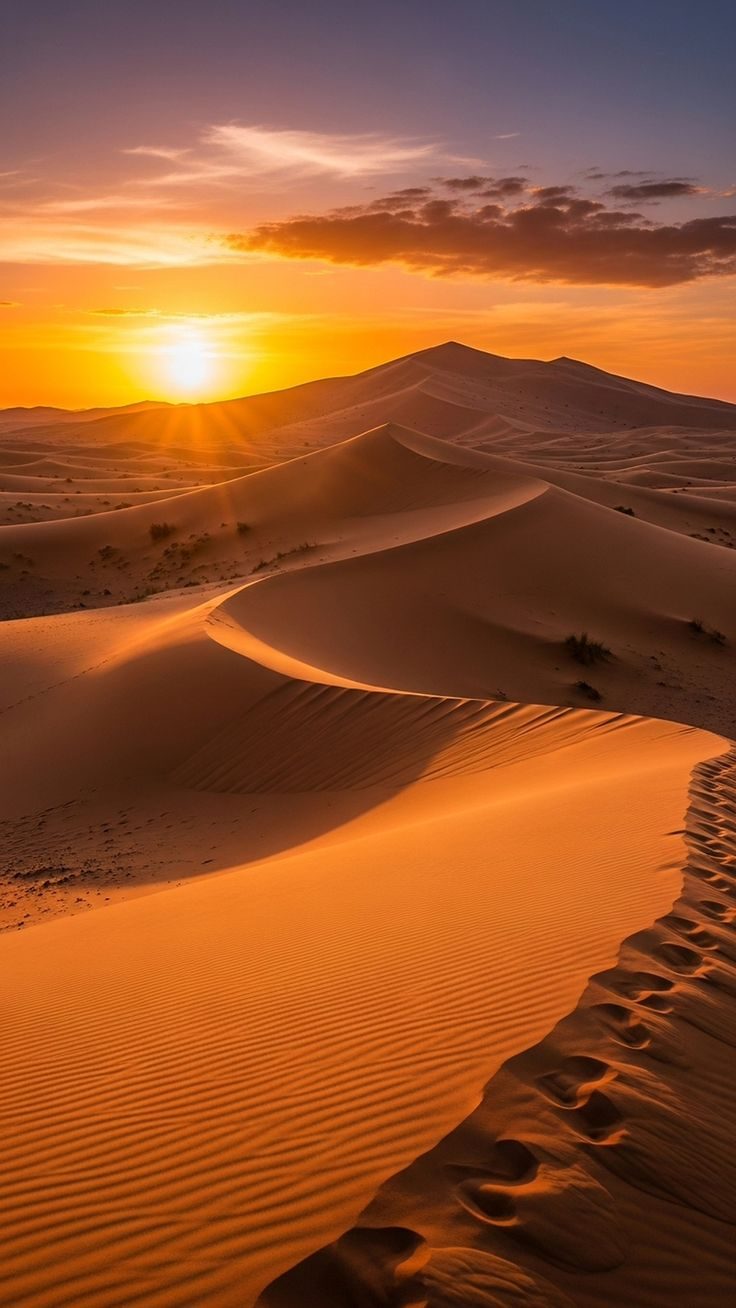
The Erg Chebbi dunes near Merzouga are the highest in Morocco, some rise to 150 metres, and they are among the most dramatic natural landscapes on the continent. A luxury camp at the dune line, reached after a two-day overland journey through the gorges of the south, is the experience that makes travellers return to Morocco a second time.
The first thing guests say when they arrive at the Erg Chebbi is that they had no idea it would be this large. The dunes are not a postcard strip. They stretch for fifty kilometres along the Algerian border, and they shift constantly. The sand is an extraordinary shade of deep orange in the morning, pale gold at noon, and almost red in the hour before sunset. At night, the absence of artificial light means the Milky Way is genuinely visible with the naked eye.
The second thing they say is that it is quiet. Not merely quiet. Silent. The Sahara at 5 am, before the wind picks up, has a quality of silence that is difficult to describe to people who have not experienced it. It has weight.
Merzouga is approximately 570 kilometres from Marrakech by the southern route, a journey of about nine hours of driving time if done direct. We never do it direct. The road south from Marrakech through the High Atlas is one of the most beautiful drives in the country, and the region between Ouarzazate and the dunes contains landscapes that most visitors to Morocco never see.
The journey begins early: departure from Marrakech at 7:30 am to cross the Tizi n'Tichka pass (2,260 metres) before the heat. The pass itself, with its hairpin bends and panoramas of the Atlas, takes an hour to cross. Below it, the landscape changes entirely: the green valleys of the High Atlas give way to the pre-Saharan south, ochre and vast, studded with palmeraies (palm oases) and kasbahs.
We stop at the Kasbah Aït-Ben-Haddou, a UNESCO World Heritage site and one of the best-preserved earthen architecture ensembles in North Africa, for a private guided visit before the crowds arrive. Lunch is arranged at a terrace restaurant above the Draa valley. The afternoon drive follows the Valley of the Roses to the Dades Gorge, where we spend the first night at a property we have selected specifically for its silence and its view of the canyon walls at sunrise.
The second morning brings the Todra Gorge, a slot canyon whose limestone walls rise 300 metres on either side of the river, and whose light between 9 and 11 am is extraordinary for photography. After the gorge, the road opens into the Tafilalet plain, and the dunes appear on the horizon an hour before you reach them: a dark line against the sky that gradually resolves into the Erg Chebbi.
Arrival at the camp is timed for late afternoon. Guests leave their vehicle at the edge of the dune field and transfer to the camp by camel or on foot, the approach across the sand, with the camp visible at the base of the largest dune, is part of the experience we design carefully.
The camps we work with have nothing in common with the shared tourist encampments that line the access road. The tents are large, typically 40 to 60 square metres, with proper beds (not cots), private bathrooms with hot water, electricity, and in some cases heated floors for the cold desert nights of winter. Each camp has a private dining area and a fire circle separate from other guests.
Dinner is served under the open sky, between the tents and the dune. The camp kitchen prepares a full Moroccan dinner (harira soup, a slow tagine, pastilla for dessert, mint tea), and the meal continues for as long as guests wish, with a Amazigh music session around the fire if requested.
We wake guests at 5:15 am for the sunrise journey. This is not optional. The sunrise over the Erg Chebbi, viewed from the crest of the dune you ascend on camelback in the dark, arriving at the top exactly as the light breaks, is the singular moment of the entire southern circuit. It cannot be described adequately. It should be seen.
The standard Celeste Trails Sahara circuit is three nights from Marrakech: one night in the Dades Gorge, one night in the luxury desert camp, and a return via a different route through Rissani and the Ziz valley. The circuit can be extended to five nights with additional stops at the Rose Valley, Tinghir, and the ancient ksar of Erfoud.
We will plan the entire circuit, from your Marrakech riad to the dune line and back, around your dates, your party, and the level of comfort you want in the desert.
Request a Private Proposal →Winter nights in the Sahara (November–February) reach 0°C or below. A warm sleeping layer and a down jacket are essential, even if the afternoon was 25°C. Summer nights rarely fall below 25°C. Light clothing is sufficient. A headtorch (headlamp) is useful for navigating between tent and fire at night. Sunscreen factor 50+ and a wide-brimmed hat are non-negotiable for the daytime dune ascent.
The Erg Chebbi offers two golden windows: the hour after sunrise and the hour before sunset. Between 10 am and 4 pm, the light is harsh and flat. We time all dune walks and camel journeys around these windows. For guests with serious photographic intent, we can arrange a private guide with knowledge of the specific dune crests and compositions that produce the most memorable images.